SOLIDEX®-ISOEx Untouched Human CD8+ T Cell Isolation Kit (Column-based)
Order Information
| Catalog No. | Product Name | Size | Price (USD) |
|---|---|---|---|
| GM-CD8-T-Cell-iso-kit-10T | SOLIDEX®-ISOEx Untouched Human CD8+ T Cell Isolation Kit (Column-based) | 10 Tests | USD 190.00 |
| GM-CD8-T-Cell-iso-kit-50T | SOLIDEX®-ISOEx Untouched Human CD8+ T Cell Isolation Kit (Column-based) | 50 Tests | USD 570.00 |
| GM-CD8-T-Cell-iso-kit-100T | SOLIDEX®-ISOEx Untouched Human CD8+ T Cell Isolation Kit (Column-based) | 100 Tests | USD 1,004.00 |
| GM-CD8-T-Cell-iso-kit-750T | SOLIDEX®-ISOEx Untouched Human CD8+ T Cell Isolation Kit (Column-based) | 750 Tests |
Specifications
- Cell Population CD8-T Cell
- Labeling Type Indirect
- Bead Type Non-releasable
- Format Column-based
- Isolation Method Negative CD8-T Cell Isolation (Untouched)
- Storage Store at 2℃ - 8℃
Description
| Catalog No. | GM-CD8-T-Cell-iso-kit |
| Product Name | SOLIDEX®-ISOEx Untouched Human CD8+ T Cell Isolation Kit (Column-based) |
| Description | SOLIDEX®-ISOEx Untouched Human CD8+ T Cell Isolation Kit (Column-based) is a Indirect CD8+ T Cell Isolation Kit (Column-based, Non-releasable) |
| Application | SOLIDEX®-ISOEx Untouched Human CD8+ T Cell Isolation Kit (Column-based) is used for Negative CD8+ T Cell Isolation (Untouched), with the Key Features, such as Preserves native cell function; maintains surface marker integrity; ideal for functional studies |
| Components |
|
| Labeling Type | Indirect |
| Bead Type | Non-releasable |
| Format | Column-based |
| Key Feature | Preserves native cell function; maintains surface marker integrity; ideal for functional studies |
| Cell Population | CD8-T Cell |
| Storage | Store at 2℃ - 8℃ |
Application
Protocol
- Preparation: Prepare a single-cell suspension from cryopreserved or fresh PBMCs.
- Labeling: Add the Biotin-Antibody Cocktail (targets non-CD8+ cells) to the cell suspension. Incubate.
- Bead Binding: Add Anti-Biotin Microbeads to bind the labeled non-target cells. Incubate.
- Separation: Apply the suspension to the separation column placed in a magnetic field.
- Elution: Unlabeled CD8+ T cells pass through the column freely and are collected in the flow-through fraction (Untouched).
Validation Data
Efficient Enrichment of High-Purity CD8+ T Cells from Human PBMCs Using SOLIDEX®-ISOEx Untouched Human CD8+ T Cell Isolation Kit (Column-based)
Catalog No. GM-CD8-T-Cell-iso-kit
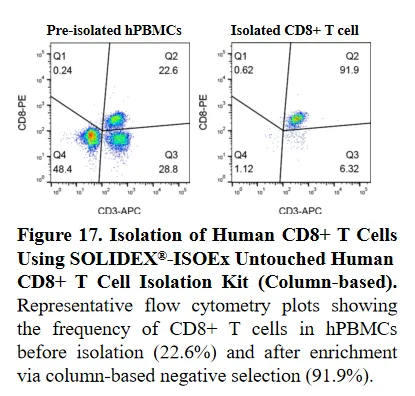
To evaluate the isolation efficiency of the SOLIDEX®-ISOEx Untouched Human CD8+ T Cell Isolation Kit (Column-based), CD8+ T cells were enriched from human peripheral blood mononuclear cells (hPBMCs) via negative selection. Non-target cells were labeled with a biotinylated antibody cocktail and depleted using magnetic beads within a separation column.
Cell fractions were stained with CD3-APC and CD8-PE for flow cytometric analysis. The frequency of CD8+ T cells demonstrated a substantial increase from 22.6% in the pre-isolation sample to 91.9% in the post-isolation fraction. These results confirm that the column-based system provides superior depletion of non-target populations, yielding highly purified "untouched" CD8+ T cells.
Figure 17. Isolation of Human CD8+ T Cells Using SOLIDEX®-ISOEx Untouched Human CD8+ T Cell Isolation Kit (Column-based). Representative flow cytometry plots showing the frequency of CD8+ T cells in hPBMCs before isolation (22.6%) and after enrichment via column-based negative selection (91.9%).
Background
Why Choose SOLIDEX®-ISOEx Untouched Human CD8+ T Cell Isolation Kit?
- 100% Untouched Cells: Target CD8+ T cells are never bound by antibodies or beads, preventing receptor blocking and accidental activation.
- Superior Purity: Column-based separation acts as a physical filter, significantly reducing background contamination compared to column-free methods.
- High Viability: Gentle isolation preserves the metabolic health of cytotoxic T cells for sensitive functional assays.
- Fast & Simple: Streamlined protocol allows for isolation in under 45 minutes.
FAQ
What are the sample requirements?
Can I stain the cells for Flow Cytometry immediately after isolation?
How does the Column-based separation work?
Are the separation columns reusable?
What is the advantage of Column-based over Column-free methods?
Is this protocol compatible with automated systems?
Need more data or case studies about this product?
✉ Contact Us / Get a Quote